Showing posts with label Introduction. Show all posts

January 26, 2016

Narrow-Minded - Part 2

Hopefully the first part of "Narrow-Minded" peaked your interest in narrow gauge railroads. Now you're probably wondering how to model them....

For the longest time, if you wanted to model a narrow gauge railroad, you had to purchase brass locomotives and rolling stock. A wide variety of products were available for many different prototypes, but they were expensive.

The Bachmann On30 Mogul.
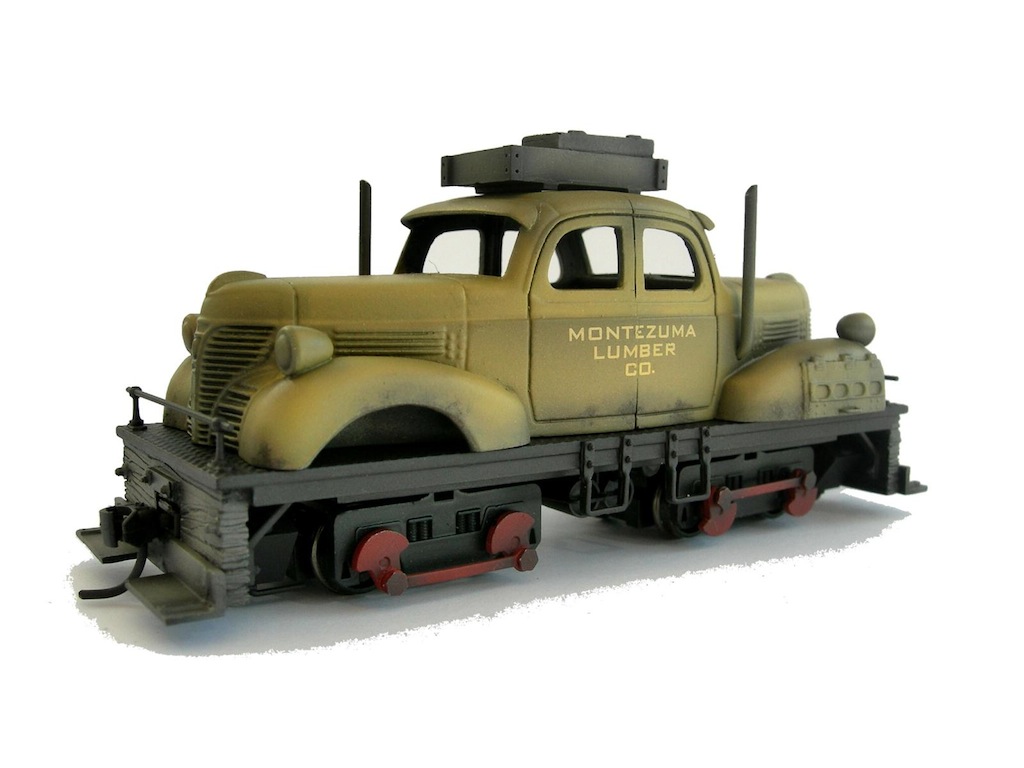
A Backwoods Miniatures critter on a Bachmann HO chassis.

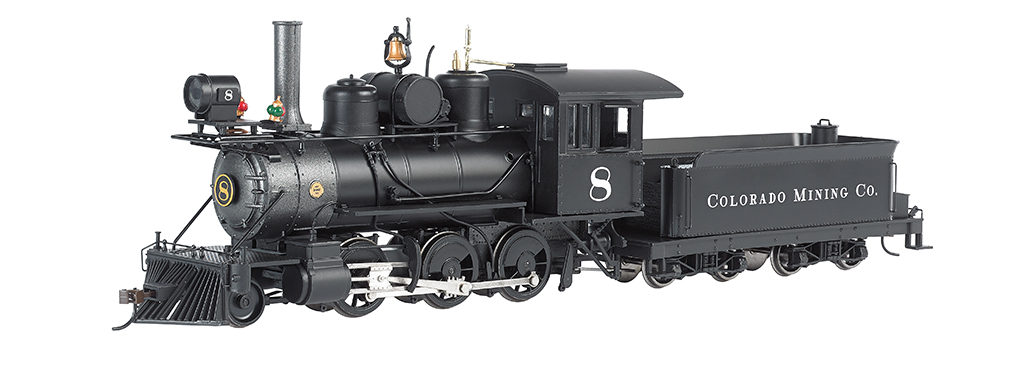
In the late 1990s, Bachmann released a O scale (1:48) 2-6-0 Mogul based on a Colorado & Southern (3' gauge) prototype. There were two unique things about it. First, it was plastic, and second, it was an On30 locomotive. On30 (also known as On2½) uses O scale models that run on HO scale track (16.5 mm), which scales out to be 30" wide in O scale. It's an inexpensive way to model "thin gauge," and it can be used to represent a variety of different gauges. One of the coolest things (in my opinion) about On30 is that you can modify HO locomotives to get some really unique results which are full of character. This scale has led to the creation of several small businesses which offer rolling stock and locomotive modification kits. Today, On30 is the most popular scale used to model narrow gauge. If you're looking to get started in it, check out The Pacific Coast Air Line Railway. It has a variety of information on locomotives, rolling stock, track, and scenery.

The two model railroads below show what can be achieved in On30.

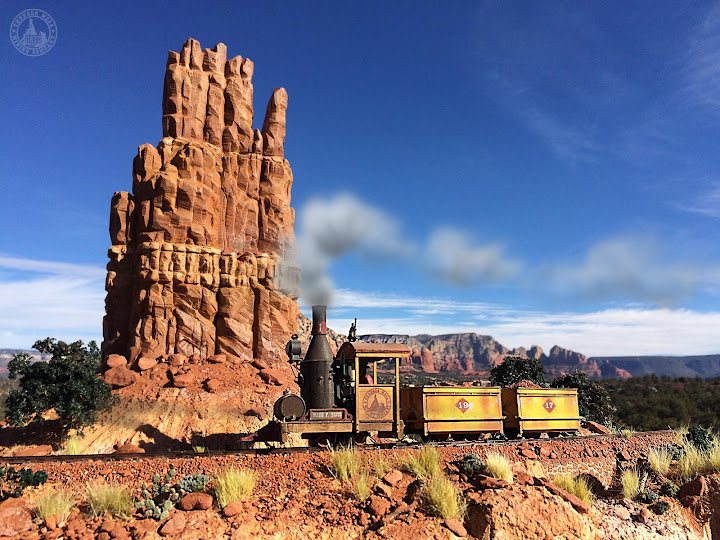
Dave Meek's Thunder Mesa Mining Co.


Troels Kirk's Coast Line Railroad.
   
I was first introduced to On30 when I received a Bachmann Christmas Mogul and some passenger cars from my next-door neighbor. After some Googling, I learned a lot about the scale and quickly gained interest. Model Railroader Video Plus's Olympia Logging Co. project railroad also intrigued me. I liked the idea of narrow gauge railroading with locomotives that weren't much larger than HO standard gauge motive power. But then I realized that all the structures were O scale, which meant that they would take up a lot more space. This wasn't good because I don't have much space to work with. Alas, there was a solution! While I gained knowledge about On30, I learned about another scale that is similar - HOn30.

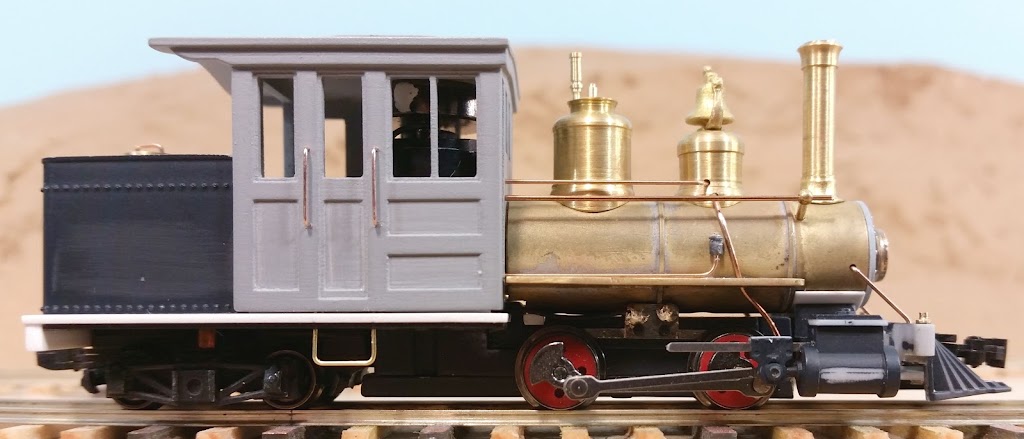
A Marsh Creek Miniatures 3D Printed Porter.
A Minitrains 0-4-0 locomotive modified by Chris Schmuck.
HOn30 (or HOn2½) follows the same principle as On30. It is HO (1:87.1) scale locomotives running on N scale track (9 mm), which also scales out to 30" in HO. It can also be used to model a variety of gauges, but it's most commonly used to represent the Maine two-footers. Originally, the first HOn30 equipment was produced by Associated Hobby Manufacturers (AHM) in the 1960s under the name "Minitrains." Bob Hayden and Dave Frary pioneered in in the scale, building several layouts: the Elk River Line, Thatcher's Inlet, and two versions of the Carrabasset & Dead River. Several HOn30 brass models were produced in the 1980s and 90s, after the Minitrains line went out of production in the 70s. The scale wasn't very popular at the beginning of the 2000s, but recently, it has been making a comeback. Both Big City Hobbies (BCH) and a German company have revitalized the Minitrains line, allowing many to get started with high quality, well running models. (The German Minitrains focus both on European and American prototypes and are available from the Original Whistle Stop and Caboose Hobbies in the U.S.) 3D printing and small businesses have greatly increased the number of products available. Even Bachmann has gotten involved with the release of "Skarloey" in their Thomas & Friends line. This scale is perfect for me because it is just like On30 but in a smaller space! If you're interested, check out the HOn30 Home Depot for more information. Also, take a look at Rich Brungard's "HOn30 Modeler Roundup" on his business's (Marsh Creek Miniatures) blog.

Thatcher's Inlet, built in the 1970s.


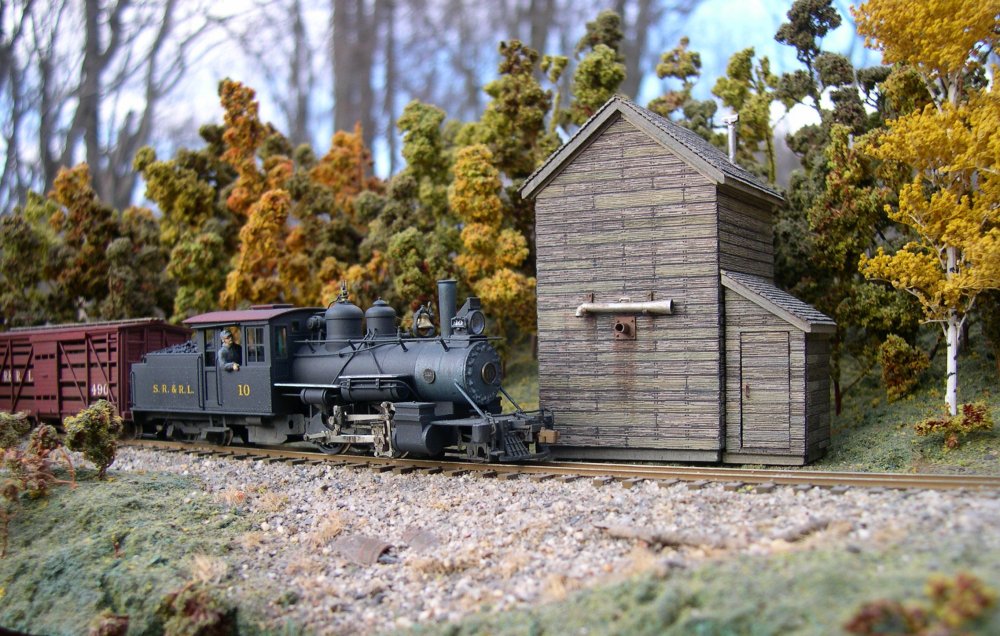
Chris McChesney's Sandy River & Rangeley Lakes No. 10 and White Birch Water Tank.
   
I've hope you've learned how inexpensive (compared to brass) narrow gauge modeling can be. Give it a try, whether you choose On30 or HOn30. I'm really excited myself to hop aboard the HOn30 express and have fun as I go for the ride!

January 14, 2016

Narrow-Minded - Part 1

In the late 19th Century, when the United States was beginning to develop a network of railroads, many prospective entrepreneurs chose to build narrow gauge lines, influenced by some which already existed in Europe. These "thin gauge" railroads have track where the distance between the rails is less than 4' 8 1/2", which is standard gauge. The most common width is 3', but a variety of other widths exist, such as 2' (common in Maine) and 30".

3' gauge No. 6 on the Baltimore & Lehigh RR, a predecessor to the Ma & Pa.
But why would anyone want to build a railroad that couldn't interchange cars with a standard gauge line? Well, this was the way to go for a cheap, quick, and easy railroad. Narrow gauge railroads provided great economic savings as they required smaller infrastructure and equipment. As a result, each railroad had a unique locomotive roster and owned all of the rolling stock on the line. Also, they could have tighter curves and steeper grades, allowing them to go places where standard gauge couldn't.

The narrow gauge boom quickly died out towards the turn of the century as most lines were either abandoned or consolidated to form a larger railroad which was converted to standard gauge. However, some managed to stick around.

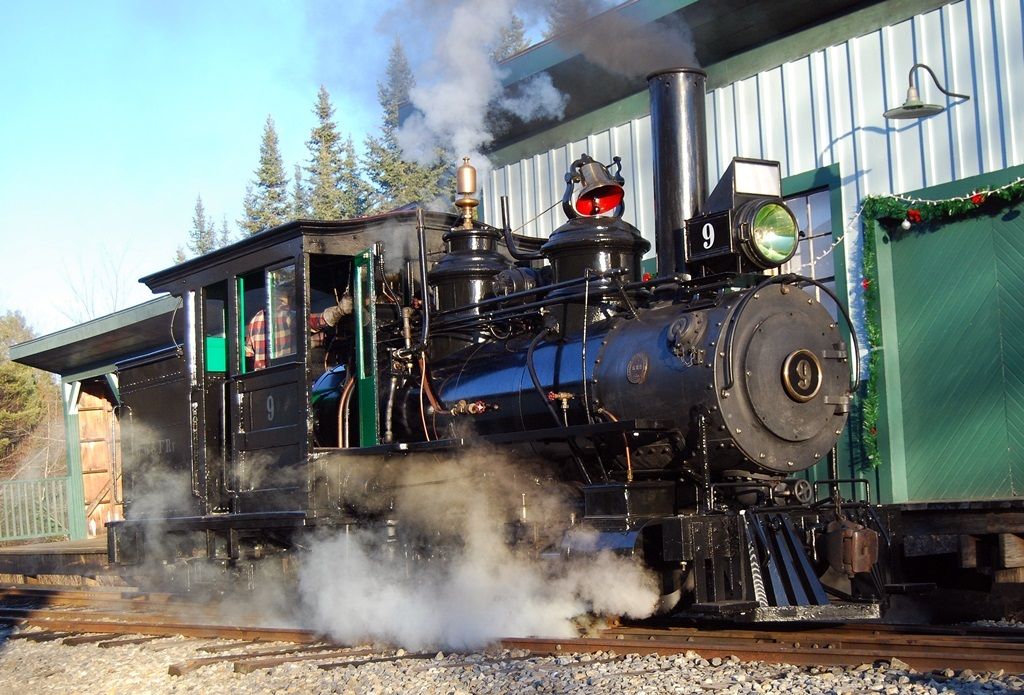
Restored WW&F No. 9 in Alna, ME.
A cluster of railroads with only two feet between the rails served the harbors, mills, quarries, forests, and farms of Maine from the 1870s to the 1940s. Their diminutive equipment included forney locomotives (0-4-4T and 2-4-4T) and boxcars that were 28' long. George Mansfield was influenced by a narrow gauge line in England, and as a result, he constructed the Billerica & Bedford in 1875, the first two-footer. Eventually, five two-foot railroads emerged from several mergers: Sandy River & Rangeley Lakes; Wiscasset, Waterville, & Farmington; Bridgeton & Saco River; Monson; and Kennebec Central. (These are in order from longest to shortest length.) The last in operation was the Bridgeton & Saco River, which closed in 1941. Fortunately, Ellis D. Atwood, bought its remaining equipment, along with two Monson locomotives and SR&RL rolling stock, which he operated on his cranberry plantation in Massachusetts. Eventually, his operation expanded into a tourist attraction, named the Edaville Railroad. Thanks to Atwood, many pieces of two-footer equipment were saved. Today, there are five locations with two-footer museums. (Some also have operating equipment, too!)
  1. Sandy River & Rangeley Lakes Railroad Museum - Phillips, ME
  2. Wiscasset, Waterville, & Farmington Railroad Museum - Alna, ME
  3. Bridgeton Historical Society Musuem (Bridgeton & Saco River) - Bridgeton, ME
  4. Boothbay Railway Village - Boothbay, ME
  5. Maine Narrow Gauge Railroad Co. & Museum - Portland, ME

No. 15 with a tourist excursion.
The East Broad Top Railroad and Coal Company operated a 3' gauge line in central Pennsylvania. It transported coal from its mines to the Pennsylvania Railroad interchange in Mount Union, PA. Mount Union also was where the railroad conducted a unique process. It put narrow gauge trucks on standard gauge freight cars, which allowed them to be delivered to customers along the line. The railroad also provided passenger service using coaches and gas-electric "doodlebugs." In April 1956, operations ceased. The employees went home but never returned, and as a result, the shops and facilities were left exactly as they were in the 1950s. The railroad was purchased by the Kovalchick Salvage Corporation and was going to be scrapped, but fortunately, its president decided to reopen the line as a tourist attraction in 1961. It held public excursions until 2011, when the railroad was shut down again, because its owners and the East Broad Top Preservation Association (which operated the line from 2009-2011 through a lease) could not reach an agreement. Currently, it is cared for by members of Friends of the East Broad Top and will hopefully be reopened sometime in the future.

There are many other narrow gauge lines still in existence. One that comes to mind is the Denver & Rio Grande Western. I'd write a summary about it, but most of my knowledge lies with railroads in the east.

Check back in the next week or so for the second part of this post which will concern modeling narrow gauge railroads, particularly by using HOn30 and On30 scales.

December 30, 2015

Now Arriving...

...trains to points east. Growing up on the east coast, I've been exposed to many railroads - existing in the past and present, large and small. But there's still much to learn and plenty to share, so come along for the ride as I share my train-related trips, trials, and tribulations!

If you haven't noticed, the photo at the top of this page is one of Amtrak's "Cities Sprinters" used to pull high-speed passenger trains. Along with these stainless steel locomotives and their consists, I tend to see Norfolk Southern and CSX freights several times a week. I enjoy railfanning these lines as time allows, but my fascination also lies in older fallen-flag railroads - particularly the Maryland & Pennsylvania Railroad and the Western Maryland Railway.

The Maryland & Pennsylvania Railroad, affectionately known as the Ma & Pa, was a 77.2 mile shortline which ran from Baltimore, MD, to York, PA. This small line served a few large cities and many farm communities, hauling milk, slate, and other commodities. Its short trains traveled through the hills, along creeks, and around sharp curves. The Maryland division was scrapped in 1958; however, the Pennsylvania division continued operations until 1985. The railroad survives through the York Railway Co., which is operated by Genessee and Wyoming. Several parts of the railroad right-of-way survive and some structures are still intact. The memory of the railroad lives on through its historical and preservation societies. The historical society each year holds a "White Flag Extra" where its members visit the areas where the railroad once ran. The preservation society has preserved structures and track in Muddy Creek Forks, PA, and turned it into a heritage village to educate the public about the railroad and the milling operations which once took place there.

The Western Maryland Railway was much different from the Ma & Pa. This Class I railroad, known as the "Fast Freight Line," spread west from the Port of Baltimore to rural areas and the Appalachian coal fields. It shipped a variety of materials, a primary one being coal. This is my favorite aspect of the WM, as I find the railroads which climbed the Appalachians interesting. The railroad was a part of the "Alphabet Route," a group of railroads which worked together to connect the Midwest with the Northeast to compete with larger railroads. The WM continued independent operation until 1973 when it became part of the Chessie System. Several parts of its trackage are still in use today by CSX or shortlines carrying tourists and freight. The railroad's historical society maintains a museum and a collection of archives in the former WM station in Union Bridge, MD.

After all that talk about full-size railroads, here are some words about modeling them.

I began my model railroading career with a Bachmann HO scale Thomas the Tank Engine train set. This quickly expanded to include more locomotives, track, and structures. For a while, I had a 5' x 9' plywood table setup to experiment with track arrangements and operations. A few months ago, that table came down in preparation for a larger (and complete) model railroad. I played around with several trackplans and prototypes, but I could not settle on one plan or one railroad. Recently, I've decided to change my direction in two different ways:
  1. Layout Size: I'm going to pursue a mini layout (or layouts). These small layouts are usually no more than 8 square feet and feature tight radii and selective compression. Even though they can be challenging for a beginner, mini layouts allow you to have a complete and finished railroad in a relatively short amount of time. (I've already started on a Western Maryland 24" x 35" layout!)
  2. Scale (sort of): Even though HO scale is the most popular scale, not all equipment is suited to run on a layout with extremely tight curves and close clearances. However, I've always liked narrow gauge railroads, and since they were squeezed into tight places, a narrow gauge railroad wouldn't be out of place on a mini layout. I thought about On30 (O scale trains on HO track) for a while, but I decided that O scale was too big for my taste. But I still wanted narrow gauge railroading without having to pay for expensive brass locomotives.... Then I discovered HOn30, which is HO scale trains on N scale track! It allows me to still model in HO, but I get to have narrow gauge! HOn30 is growing in popularity. Minitrains (a European company) has a line of several locomotives; several new companies are springing up with new products; and the recent innovation of 3D printing allows small objects to have incredible amounts of detail. HOn30 also tends to be more whimsical than standard gauge HO, which allows me to be creative and innovative.
These are my current model railroad plans, but in the future I hope to build a large Western Maryland and Ma & Pa layout when I have more space and time.

I hope you'll visit this blog from time to time to read about what I've been up to, whether I'm watching Amtrak trains whiz down the tracks, exploring the railroads of yesteryear, or building models of trains which will chuff through the forest.